Summer Focus SALE... 70% off ending soon!
Do you know what's limiting your image sharpness?
The Tack Sharp Photography Guide is here to help 🎯
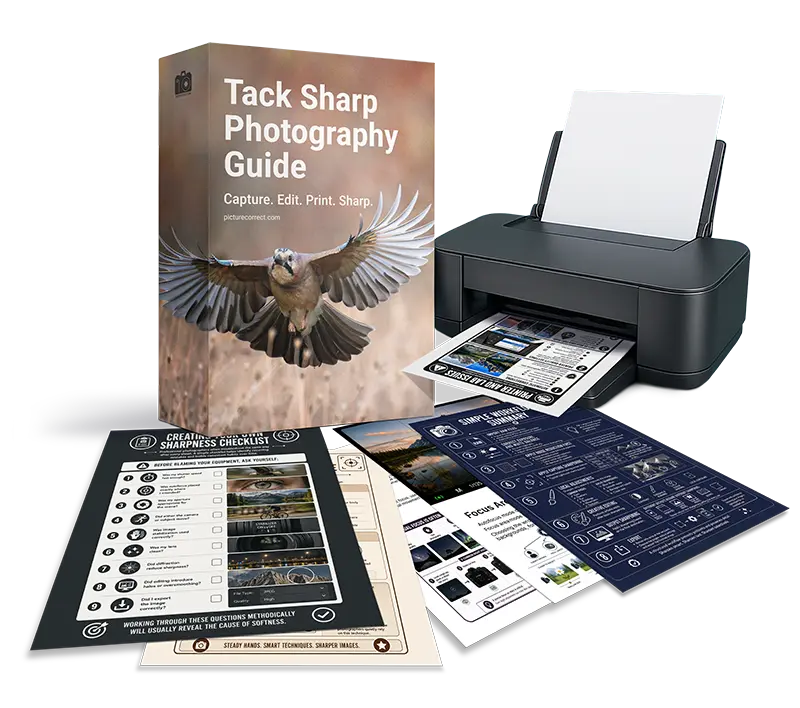
A complete system for consistently capturing tack-sharp photos—from camera settings and focusing to editing and printing.
- Capture crisp, detailed photos in virtually any situation
- Build a reliable workflow from capture through final export
- Download to any device or print pages to keep in your camera bag
AS FEATURED ON:






Finally Capture Photos That Are Truly Tack Sharp
You’ve seen the photos. Perfectly crisp eyes in portraits. Razor-sharp landscapes from foreground to background. Wildlife frozen in incredible detail. Prints that stay sharp even at large sizes.
Then you head out with your camera… and your photos look just a little soft.
Sometimes it’s missed focus. Sometimes it’s camera shake. Sometimes the editing makes things worse instead of better. The frustrating part is that it isn’t always obvious why your images aren’t sharp. That’s exactly why this guide was created.
A complete system
From Capture to Print
- Wondering why your photos aren't perfectly sharp
- Struggling with focus accuracy and camera settings
- Getting inconsistent results from one shoot to the next
- Choose the sharpest camera settings for any situation
- Eliminate camera shake and motion blur
- Shoot tack-sharp landscapes, portraits, wildlife, sports, macro & night
- Sharpen properly in Lightroom and Photoshop
- Master autofocus and manual focus techniques
- Understand lens sharpness and the ideal aperture
- Use focus stacking for front-to-back sharpness
- Use AI sharpening without unnatural artifacts
Included Bonuses Today:
Camera Cheat Sheets
Printable camera settings, handheld shutter speed guides, lens sweet-spot charts, exposure references, and focus guides for the field.
30-Day Tack Sharp Challenge
Guided exercises, focus drills, and real-world assignments that build the habits professional photographers use to shoot consistently sharp images.
Photo Editing Workflows
Printable sharpening order guides, export setting references, noise reduction guidelines, print-prep checklists, and resolution charts.
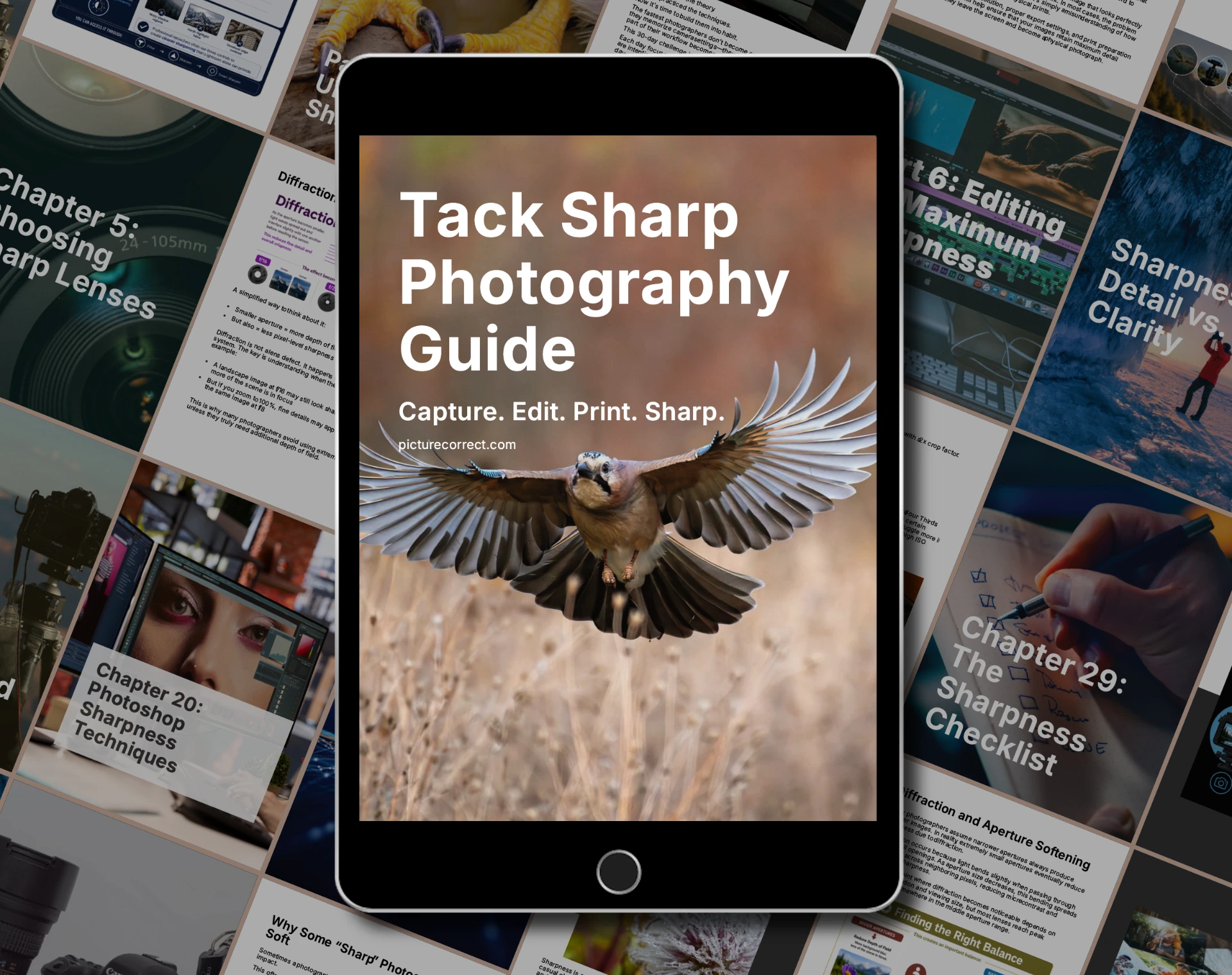
Table of Contents (359 Pages)
Introduction
- Why Sharpness Matters More Than Ever
- What “Tack Sharp” Actually Means
- The Three Stages of Sharpness: Capture, Edit, Print
- Sharpness vs. Detail vs. Clarity
- Common Myths About Sharp Photos
- How to Use This Guide
Part 1: Understanding Sharpness
- Perceived Sharpness vs. Technical Sharpness
- Edge Contrast and Acutance
- Resolution vs. Sharpness
- Viewing Distance and Output Size
- Why Some “Sharp” Photos Still Feel Soft
- Motion Blur
- Camera Shake
- Missed Focus
- Depth of Field Mistakes
- Atmospheric Distortion
- Lens Limitations
- Heat Haze and Environmental Issues
- Diffraction and Aperture Softening
- What Happens at the Pixel Level
- Zooming In Too Far
- Sharpness on Modern High-Resolution Sensors
- Why Tiny Mistakes Become Obvious
- Understanding Micro-Blur
Part 2: Gear for Sharper Photos
- Full Frame vs. APS-C vs. Micro Four Thirds
- Megapixels and Sharpness
- IBIS (In-Body Stabilization)
- Electronic vs. Mechanical Shutter
- Sensor Cleaning and Dust Issues
- Prime vs. Zoom Sharpness
- Lens Sweet Spots
- Corner Sharpness
- Understanding MTF Charts
- Cheap vs. Expensive Lenses
- Common Soft Lens Problems
- Why Stability Matters
- Choosing the Right Tripod
- Ball Heads vs. Pan Heads
- Remote Shutters and Self-Timers
- Mirror Lock-Up and Electronic First Curtain
- Weighting Your Tripod Properly
Part 3: Camera Settings That Create Sharp Photos
- Minimum Handheld Shutter Speeds
- The Reciprocal Rule
- Subject Motion vs. Camera Motion
- Freezing Fast Action
- When Stabilization Isn’t Enough
- Sharpness for Sports, Wildlife, and Kids
- Lens Sweet Spot Apertures
- Diffraction Explained
- Balancing Depth of Field and Sharpness
- Avoiding Front-to-Back Softness
- Noise vs. Sharpness
- Why Overusing Noise Reduction Hurts Detail
- Best ISO Strategies for Maximum Detail
- Modern Sensor Performance
Part 4: Focus Like a Pro
- Single AF vs. Continuous AF
- Focus Area Modes
- Subject Tracking
- Eye AF and Face Detection
- Back-Button Focus
- Focus Placement Techniques
- Sharp Eyes in Portrait Photography
- Hyperfocal Distance for Landscapes
- Focus Accuracy in Macro Photography
- Focus and Recompose Mistakes
- Using Live View Magnification
- Focus Peaking
- Manual Focus for Night Photography
- Calibrating Focus Accuracy
- Lens Breathing and Focus Shift
Part 5: Sharpness by Photography Type
- Maximum Front-to-Back Sharpness
- Focus Stacking
- Wind and Motion Problems
- Sharpness in Long Exposures
- Tack Sharp Eyes
- Managing Depth of Field
- Lens Compression and Sharpness
- Avoiding Motion Blur in Portraits
- Tracking Fast Subjects
- Burst Shooting Strategies
- Fast Shutter Recommendations
- Autofocus Optimization
- Extreme Magnification Challenges
- Focus Stacking Workflows
- Tripod Techniques
- Diffraction in Macro Work
- Sharp Stars and the 500 Rule
- Focusing in the Dark
- Tracking vs. Non-Tracking
- Reducing Star Blur
- Atmospheric Turbulence
Part 6: Editing for Maximum Sharpness
- What Sharpening Actually Does
- Capture Sharpening
- Creative Sharpening
- Output Sharpening
- Why Over-Sharpening Looks Bad
- Detail Panel Settings Explained
- Radius, Amount, and Detail
- Masking for Cleaner Results
- Noise Reduction Without Destroying Detail
- High Pass Sharpening
- Smart Sharpen
- Frequency Separation Considerations
- Selective Sharpening with Masks
- AI Denoising
- AI Upscaling
- AI Sharpening Tools
- When AI Helps—and When It Hurts
- Avoiding the “Crunchy” Look
Part 7: Printing Sharp Photos
- Resolution Requirements
- DPI vs. PPI Explained
- Soft Proofing Basics
- Export Settings That Preserve Detail
- Why Prints Look Different Than Screens
- Sharpening for Different Print Sizes
- Paper Types and Perceived Sharpness
- Viewing Distance Considerations
Chapter 24: Common Print Problems
- Soft Prints
- Oversharpened Prints
- Incorrect Resizing
- Compression Artifacts
- Printer and Lab Issues
Part 8: Advanced Sharpness Techniques
- When to Use Focus Stacking
- Shooting Workflow
- Blending Methods
- Avoiding Halo Artifacts
- Multi-Exposure Sharpness
- Reducing Noise Through Stacking
- Sharper HDR Workflows
- Aligning Images Properly
- Enlarging Images Correctly
- AI Enlargement Methods
- Preparing Huge Prints
- Avoiding Artificial Detail
Part 9: Troubleshooting Soft Photos
- Diagnosing the Real Problem
- Soft Lens or User Error?
- Focus Errors vs. Motion Blur
- Editing Mistakes That Ruin Sharpness
- Before the Shot
- During the Shot
- Before Exporting
- Before Printing
- Capture Workflow
- Editing Workflow
- Print Workflow
- Building Consistency
Cheat Sheets Section
- Recommended Shutter Speeds
- Lens Sweet Spot Reference
- Handheld Sharpness Guide
- Focus Mode Recommendations
- “Why Is My Photo Blurry?” Quick Fix Chart
- Common Sharpness Mistakes
- Fast Solutions in the Field
- Recommended Sharpening Order
- Export Settings
- Noise Reduction Guidelines
- Best Export Sizes
- Print Resolution Quick Reference
- Paper and Viewing Distance Guide
Bonus Section
- Daily Exercises
- Focus Drills
- Sharpness Improvement Assignments
A publisher you can trust
When choosing photography resources, trust matters. You want to know you’re learning from a source that has consistently delivered value, supported its customers, and built a real community over time — not something that just appeared overnight.
(Incorporated in 2007)
(all experience levels)
That track record isn’t accidental. It comes from a long-term focus on helping photographers improve with clear, practical guidance — and backing it up with responsive support and a straightforward guarantee.
Frequently Asked Questions
Instantly, as a digital download. As soon as your order is complete, you’ll get access to download the guide to any device — no waiting on shipping.
The guide is delivered as a PDF, so it opens on any computer, tablet, or phone, and can also be printed if you’d prefer a physical copy on your desk.
Yes. The PDF is formatted to print cleanly, and the included cheat sheets are designed specifically to be printed and taken into the field.
PictureCorrect Inc. has published practical photography education for over 20 years, with guides used by millions of photographers of every experience level.
Yes. The techniques apply to any camera brand or system — DSLR, mirrorless, or otherwise — since sharpness comes down to technique, not a specific brand.
Absolutely. The guide starts with the fundamentals of focus and camera settings before building into more advanced techniques, so it works at any starting point.
Yes. Sections on focus stacking, AI sharpening, lens sweet spots, and print preparation are aimed squarely at photographers looking to refine already-solid technique.
Join the Millions of Photographers who have improved their photography through PictureCorrect Inc.
“PictureCorrect is an invaluable source of knowledge and inspiration for anyone who wants to take amazing photographs wherever they go.”
- Ian Plant
“This has been my favorite photography website for a number of years. I just wanted to thank you for providing this wonderful enjoyable and the educational articles. I continue to enjoy checking in frequently and improving my photography knowledge.”

- Ken Jones
“I was skeptical that a single eBook could cover so many things, but you managed to do it and in such great detail!”

- Mark Cooper
“It’s by far really the best photography book I’ve ever read, a helper in any situation from beginner to pro.“

- Peter Leinfellner
“A fantastic reference to remind yourself of the many techniques, settings, and concepts you might need to call upon when the moment strikes.”

- Steve Arnold
The current deal for the flash sale:
Our team of photographers, writers, graphic designers, and layout specialists have spent months creating what we believe is the most comprehensive guide we’ve ever produced on achieving tack-sharp photography.
Every chapter has been carefully researched, tested, written, and professionally designed to help photographers understand exactly why images become soft — and more importantly, how to consistently avoid it.
From autofocus techniques and camera settings to advanced editing workflows, focus stacking, AI sharpening, and preparing flawless prints, every section was created to give photographers practical knowledge they can immediately apply in the field.
The Tack Sharp Photography Guide, along with all included bonuses, normally retails for over $89. During this online flash sale, they are available for only $27.

Our products also come with a 90-day money back guarantee. If you are not completely satisfied with your purchase, simply contact us within 90 days of your purchase and we will refund your money in full. No questions asked.
Flash sale: only hours left!
$ 89
NORMAL PRICE
$ 27
PRICE TODAY
70% OFF
90-Day Money-Back Guarantee:
You love the Cheat Sheets or you don’t pay for them. Simple as that.
It's decision time! You've essentially got 2 options:
Option 1: Keep piecing it together yourself
Continue trying to figure out why some of your photos are sharp while others aren’t. Spend hours searching through videos, articles, and conflicting advice, hoping to eventually piece everything together yourself.
Option 2: Fast-track your results
Created by photographers, for photographers, this guide gives you a proven roadmap to consistently sharper images — covering camera technique, focusing, lenses, editing, printing, and everything in between. No more guessing. No more wondering why your photos turned out soft.
Love the Tack Sharp Photography Guide — or don't pay for it.
It’s that simple.